
KCSIE 2024
"Trans Children and Young People in Schools Deserve Safety and Understanding"
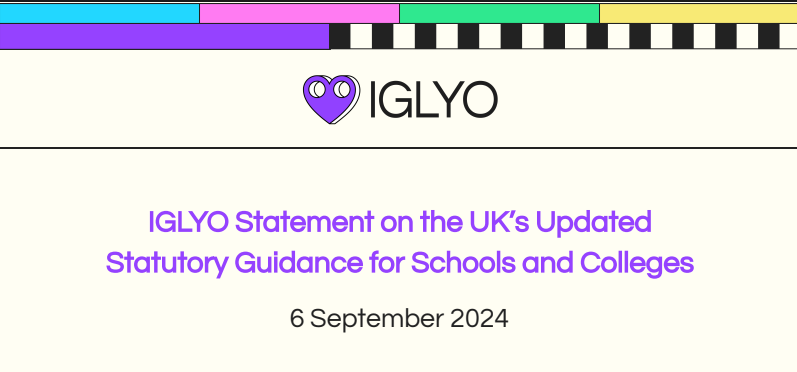
On 6 September 2024, the world's largest member-based network (IGLYO), which is dedicated to LGBTQI youth and their rights, published a statement strongly condemning the UK Government's recently released statutory safeguarding guidance, KCSIE 2024.
The statement was drafted by IGLYO with input from their UK members and inclusive education experts, and it was endorsed by ILGA-Europe and Transgender Europe (TGEU).
View the statement online
Download a PDF version of the statement
The statement was drafted by IGLYO with input from their UK members and inclusive education experts, and it was endorsed by ILGA-Europe and Transgender Europe (TGEU).
View the statement online
Download a PDF version of the statement
"We condemn the UK Statutory Guidance for Schools & Colleges and their failure to include trans and non-binary students in an affirming, supportive way."

KCSIE 2024
Take Action
Below is information about two ways you can take specific action now relating to the KCSIE 2024 updates.
A Guide to Approaching Senior Leadership About KCSIE 2024
The guide includes an example model email to initiate contact with your Designated Safeguarding Lead, with guidance on follow-up steps and preparing for a meeting. However, this could easily be adapted and applied to a headteacher, CEO of a multi-academy trust, or the chair of governors!
How to Contact Your MP - Includes Model Email
After you have found your local MP's contact details, you can follow some of our tips or use the included model email as a starting point.
Try to use your own words as much as you can, because when people send duplicate or very similar emails, they are flagged by the Parliament IT systems. It can also be really powerful to include your own personal experiences when speaking about wider political issues.
NSPCC Learning: CASPAR Briefing September 2024
This briefing clearly sets out changes to the KCSIE guidance, and provides information about other relevant safeguarding and equalities legislation that needs to be considered.
What makes this guide particularly useful, is that it also clearly outlines some of the changes that have been made to KCSIE since 2022, which include a number of measures to make the guidance more LGBT+ inclusive.
What makes this guide particularly useful, is that it also clearly outlines some of the changes that have been made to KCSIE since 2022, which include a number of measures to make the guidance more LGBT+ inclusive.
Keeping Children Safe in Education- 2024 Updates
As usual, the Department for Education (DfE) published an updated draft version of the statutory safeguarding and child protection guidance for schools in England, Keeping children safe in education (KCSIE) in May 2024. The final version was published 2nd September 2024, effective from 1st September 2024.
The guidance sets out what schools and colleges in England must do to safeguard and promote the welfare of children and young people under the age of 18.
View the KCSIE 2024 guidance here
There is currently a note at the start of page 55 in the KCSIE 2024 guidance which states that the section (which covers LGBT+ children) “remains under review, pending the outcome of the gender questioning children guidance consultation, and final gender questioning guidance documents being published”.
We have significant concerns around the content of this section.
- Paragraph 205 is unchanged from previous versions of KCSIE, except that the paragraph now only applies to lesbian, gay, and bisexual children, whereas it previously also referred to trans people. We are concerned at the implication that being trans is now to be seen as an inherent risk factor for harm, which is not the case.
- Paragraph 206 refers to the Cass Review, a government-commissioned review which has come under heavy criticism by medical professionals, human rights groups, and groups representing trans people, for its research methods and lack of expertise, as well as its conflicts with international best practice.
We are also concerned that this paragraph's mention of autism and ADHD which we believe is unnecessary and risks pathologising trans people, and implying that neurodivergent children are less able to take decisions around their own identity.
We have more information about the Cass Review here. - Paragraph 207 states that schools should encourage parents/carers to seek clinical help and advice. While not necessarily problematic, in the context of the rest of this section, it further seeks to pathologise trans children and imply that being trans is a medical condition rather than a natural part of the diversity of humanity.
- Paragraph 208 directs schools to refer to the Gender Questioning Children (GQC) guidance, and repeats some points from that document. The GQC guidance was published in draft form for consultation at the end of 2023, and no final version has been published. The draft version resulted in strong criticism from professionals from both a safeguarding and legal perspective, and schools that follow that version of the guidance are likely to be breaking the law and placing students at risk of harm.
We have more information about the GQC guidance here. - Paragraph 209 refers to the issues of lacking a trusted adult.
What should schools do?
Given that this section of KCSIE refers to unpublished guidance, and our wider concerns, we contacted the DfE to clarify whether schools are expected to follow it at this time.
When we contacted the DfE on 2nd September 2024, they were unable to confirm whether or not schools should follow the 2024 version of paragraphs 205-209 of Keeping Children Safe in Education. We followed up our query in writing and received a response on 19th September.
The DfE confirmed that KCSIE was under review alongside the "Gender questioning non-statutory guidance". However, the DfE declined to answer our question as posed, and the response was ambiguous on exactly what schools should be doing. However, they did confirm that "safeguarding and children’s welfare should be at the heart of all decisions in this area".
In the absence of clear guidance from the DfE, our interpretation is that paragraphs 205-209 of KCSIE 2024 do not apply, as they are marked as still being under review, and refer to unpublished guidance. We therefore recommend that schools should continue to follow the equivalent section from KCSIE 2023, which for reference, reads:
Children who are lesbian, gay, bi, or trans (LGBT)
203. The fact that a child or a young person may be LGBT is not in itself an inherent risk factor for harm. However, children who are LGBT can be targeted by other children. In some cases, a child who is perceived by other children to be LGBT (whether they are or not) can be just as vulnerable as children who identify as LGBT.
204. Risks can be compounded where children who are LGBT lack a trusted adult with whom they can be open. It is therefore vital that staff endeavour to reduce the additional barriers faced and provide a safe space for them to speak out or share their concerns with members of staff.
205. LGBT inclusion is part of the statutory Relationships Education and Relationship and Sex Education and Health Education curriculum and there is a range of support available to help schools counter homophobic, biphobic, and transphobic bullying and abuse.